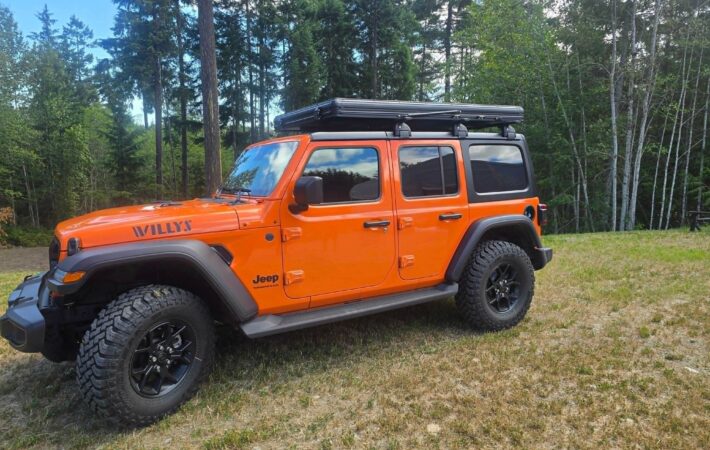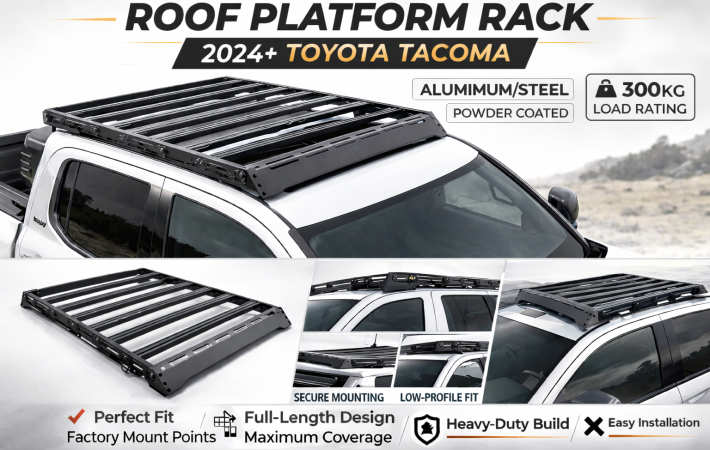

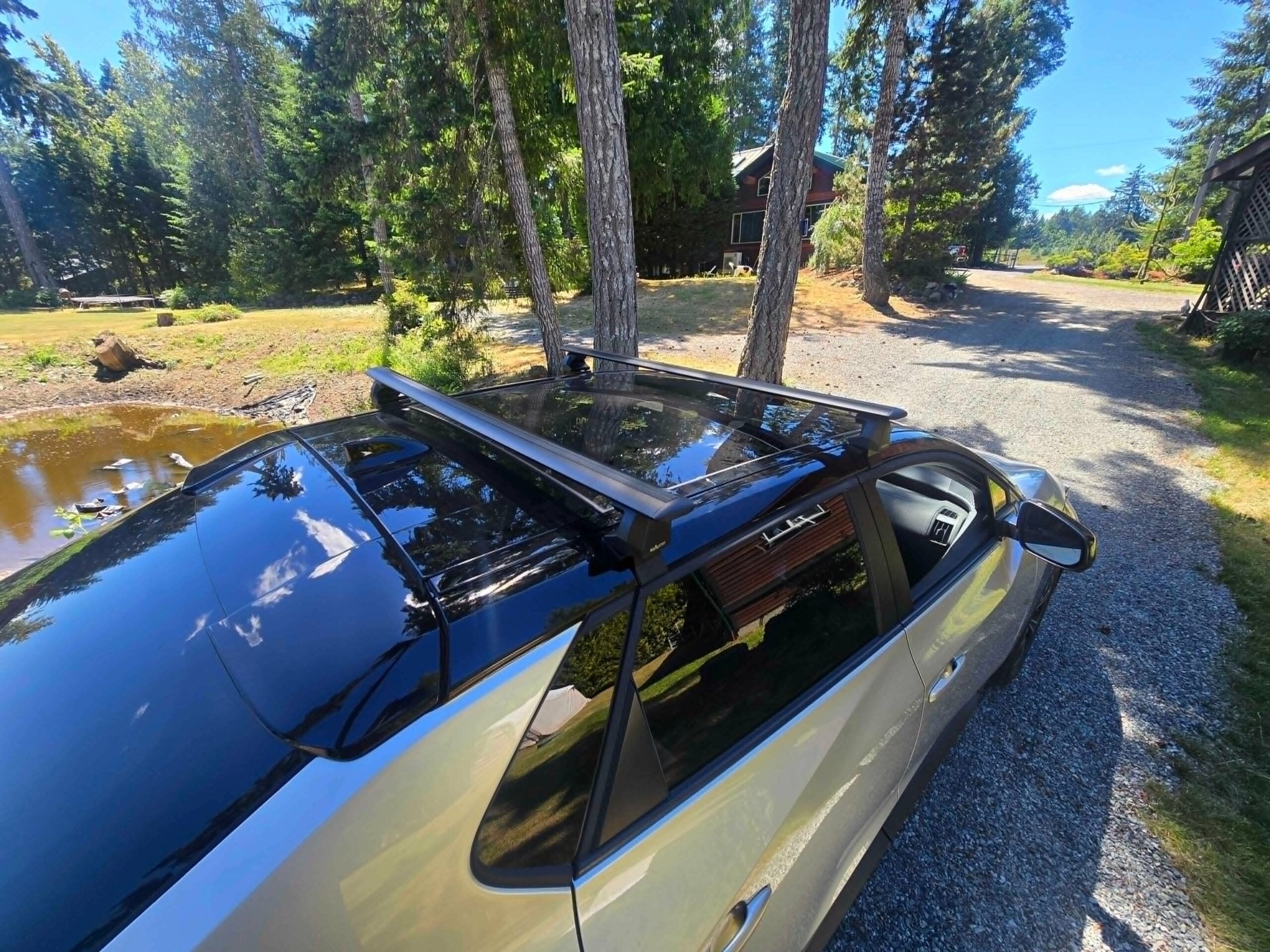
When you’re shopping for cross bars, the shape of the bar itself is easy to overlook. Most people focus on mounting compatibility — raised rail, flush rail, or naked roof — and assume the bar in the middle is just a bar. But the cross-section profile of your bars directly affects how much wind resistance you’re creating, how loud your cabin gets at highway speed, and how your loads behave when you’re passing transport trucks at 110 km/h on the Trans-Canada.
This is a real consideration in Canada, where highway driving makes up a significant portion of most overland trips — and where cross bars spend the winter loaded with snowboarders’ gear one weekend and unloaded for the Monday commute the next.
What “Aerodynamic” Actually Means on a Cross Bar
An aerodynamic or airfoil bar is shaped like a wing cross-section: a rounded leading edge that tapers to a narrower trailing edge. Air moving over the roof hits the bar at the rounded front, splits around it cleanly, and rejoins with minimal turbulence behind the bar. Less turbulence means less drag. Less drag means less noise and less fuel penalty.
A square or round-profile bar presents a flat or circular face to oncoming air. Air hits it, tumbles around it, and creates a turbulent wake behind the bar — which is where most of the cabin noise on a loaded roof comes from. The sound isn’t the roof box or the tent; it’s the bars generating turbulence that resonates through the roof.
All three of our purpose-built roof cross bar systems — ApexMount™ (naked roof), TrailRail™ (raised rail), and FlushRail™ (flush rail) — use this airfoil aluminum profile. Our entry-level FlexFit Adjustable Crossbars use a more traditional profile — which is fine for their use case, but you’ll notice the difference on a long highway run.
The Real-World Fuel Economy Impact
The exact penalty depends on your vehicle, your speed, and what’s mounted on the bars — but the principle is consistent: drag increases with the square of velocity. At 60 km/h, the drag difference between an airfoil bar and a square bar is modest. At 110 km/h, it’s roughly four times as large. That’s why highway driving is where this matters most, and it’s also why mounting a flat-profile load (roof box or platform) on poorly shaped bars makes it worse — the load catches the turbulence off the bars and amplifies it.
If you drive significant highway distances with a loaded roof — a scenario most Canadian overlanders hit constantly, driving from cities to trailheads — the airfoil shape reduces your fuel penalty in a meaningful way over a season.
Load Behavior at Highway Speed
There’s a safety dimension here too, beyond the noise and efficiency story.
At highway speeds, loads on cross bars aren’t just sitting still — they’re subject to aerodynamic lift, side loading from crosswinds, and forward braking forces. An airfoil bar creates less turbulence directly around and above the bar, which means less aerodynamic disruption to whatever’s mounted on it. Roof boxes, platforms, and bike racks all perform more predictably on a bar designed to manage airflow cleanly.
This doesn’t mean a square bar is dangerous — millions of vehicles run them — but it does mean that for a heavier or larger load (rooftop tent, full platform, cargo box), the airfoil design gives you more margin at speed. All three of our airfoil systems handle a 75 kg dynamic load — meaning 75 kg of moving, highway-speed load — which covers most roof boxes, single rooftop tents, and platform setups well within their working range.
For the rooftop tent side of this, we carry the full Rooftop Tents and a range of universal and vehicle-specific platforms — all designed to work with the same airfoil cross bar systems.
When a Basic Bar Is Fine
There’s no point paying for aerodynamics you won’t use. If you’re putting a simple bike rack on for weekend rides, pulling it off before Monday, and doing mostly city or secondary-highway driving, the FlexFit Adjustable Crossbars at $45 CAD get the job done without overbuilding the setup.
The calculus tips toward airfoil bars as soon as:
- Your bars stay mounted year-round
- You regularly drive highway distances with a load up top
- You’re running a rooftop tent or platform that will be there for the whole season
- Wind noise matters to you (or your passengers)
Quick Comparison
| Feature | Airfoil (ApexMount™ / TrailRail™ / FlushRail™) | Traditional Profile (FlexFit) |
| Wind noise | Significantly reduced | More turbulence at speed |
| Fuel economy impact | Lower drag, better on highway | Higher drag with loads |
| Dynamic load rating | 75 kg | Varies by model |
| Best use case | Year-round, highway, tents, platforms | Occasional loads, budget builds |
| Price range | $295–$369 CAD | From $45 CAD |
If you’re unsure which setup makes sense for how you actually drive, get in touch with the Rooftop Tents team — we can help spec the right system for your vehicle and your typical trip profile.