
Every overland build eventually hits the same fork in the road: you need more storage up top, and you’re staring at two products that look like they do the same thing. A roof platform and a roof basket both bolt to your crossbars. Both get marketed as “essential overland gear.” And both will absolutely cost you money and regret if you buy the wrong one for your setup.
Let’s break down the actual differences, not just the spec-sheet ones.
Start With This Question: What’s Living on Your Roof?
Before comparing load ratings or price, ask yourself what’s actually going up there long-term. That answer decides this whole debate.
Sleeping on the roof? You’re a platform buyer.
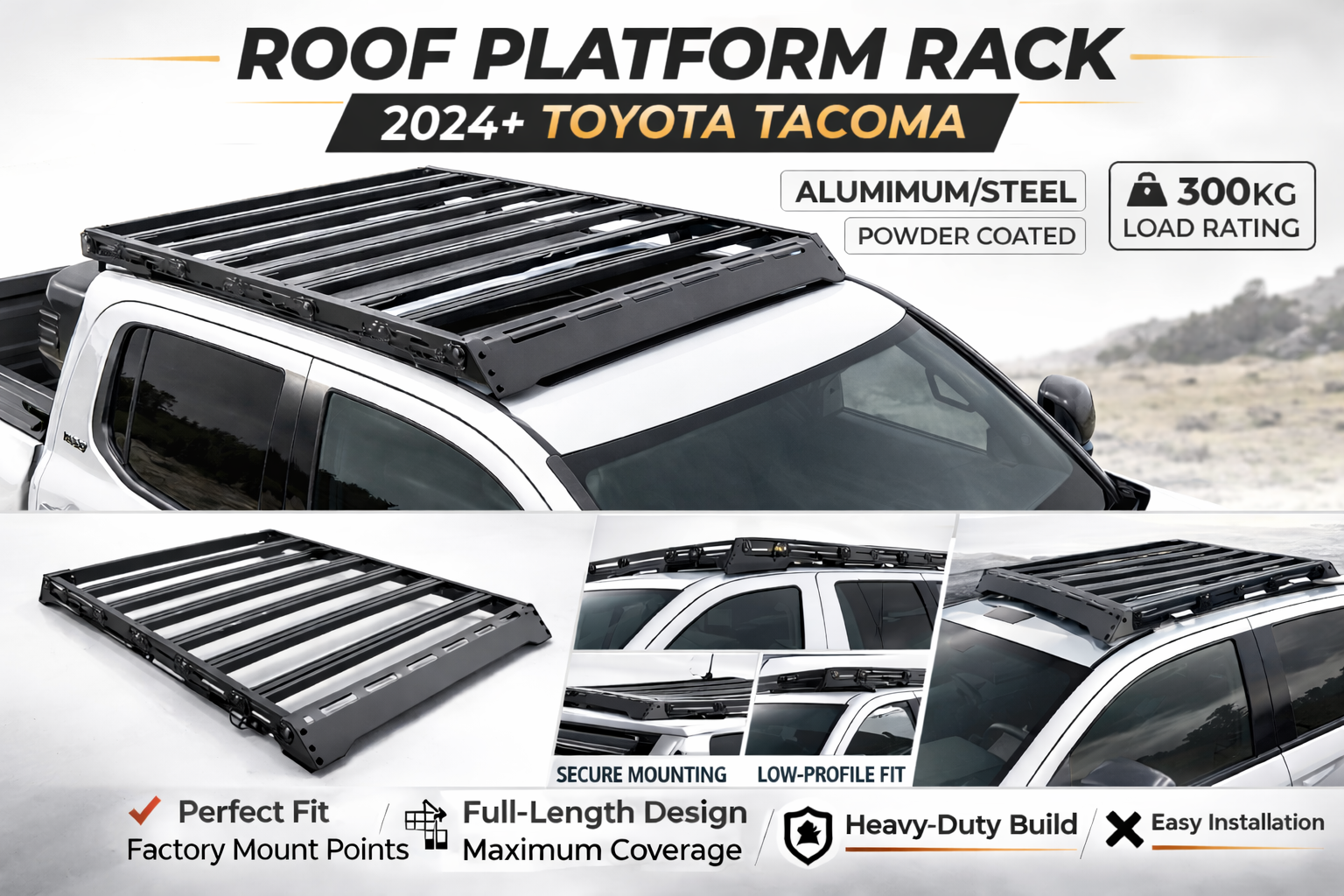
If your build includes a rooftop tent, browsing available roof platforms before purchasing can help you identify the mounting options and load capacities that best suit your vehicle.
Hauling bins, totes, and loose gear? You’re a basket buyer.
Both? Keep reading — there’s a setup for you too.
Roof Platforms: The Foundation Layer
A platform is a flat aluminum deck, usually slatted or perforated, designed to act as a mounting surface rather than a storage container in its own right.
Strengths:
Built for rooftop tents. Hard-shell and soft-shell tents are engineered around a flat mounting surface. The slats also allow airflow underneath the tent floor, which cuts down on the condensation buildup that ruins a lot of RTT mattresses in humid or coastal climates.
This is why many overlanders choose a dedicated roof platform as the foundation of their rooftop camping setup, especially when adding tents, awnings, and other roof-mounted accessories.
Aerodynamics. A platform sits lower and flatter than a basket’s walls, reducing the wind resistance that shows up as wind noise on the highway and a few extra MPG lost at the pump.
Accessory-friendly. Side awnings, solar panel mounts, MOLLE panels, and traction board brackets all attach cleanly to a platform’s edge rails without a wall getting in the way.
Even weight distribution. The flat deck spreads load across the full surface instead of concentrating it in a center basin, which matters once you’ve stacked a tent, bedding, and an awning on the same square footage.
Tradeoffs:
Without a wall, loose or odd-shaped items can shift in transit unless you’re using cargo nets or straps.
Platforms generally cost more per square foot than baskets of similar size.
Roof Baskets: The Cargo Workhorse
A basket is the classic wire-mesh or solid-panel cage that’s been strapped to overland rigs for decades, and for good reason — it’s an efficient way to move volume.
Strengths:
Containment. Walls keep coolers, dry bags, fuel cans, and camp totes from sliding around, which a flat platform can’t do on its own.
Cost-efficiency. You generally get more cargo volume per dollar with a basket than with a platform.
Built-in tie-down points. Most baskets ship with mesh or rail anchor points along the walls, so you’re not drilling or improvising lashing points.
Tradeoffs:
Mounting a rooftop tent means adding a base panel first — typically plywood or aluminum — which adds weight, cost, and installation time, and still isn’t as clean as a purpose-built platform.
More wind drag. The open wall structure catches air at speed, which is noticeable both audibly and on fuel consumption over long highway stretches.
Awning and solar panel mounting is less straightforward since you’re working around wall height instead of a flat deck edge.
Matching the Product to the Build
If your rig runs a rooftop tent + awning + solar combo: the platform isn’t a nice-to-have, it’s the structural piece everything else depends on. This is the setup overlanders run when the roof functions as a complete basecamp — tent up top, awning off one edge, solar panels feeding the battery bank, all mounted to the same deck.
A properly rated roof platform system provides the mounting surface needed to safely integrate multiple accessories into a single overland setup.
If your rig is built for moving gear, not sleeping on the roof: a basket gets you more usable cargo space for less money, with zero tent-mounting compromises to work around.
If you want both: plenty of builds run a platform toward the front of the roof for the RTT and a smaller basket or hitch-mounted cargo box further back for loose items. It works — just be honest with yourself about your vehicle’s dynamic roof load rating before you stack two systems plus a loaded tent on top. That number is almost always lower than people expect, and it’s the number that matters while you’re driving, not parked.
Before You Order, Check These
Crossbar spacing and mounting hardware compatibility — most systems adjust, but confirm before purchase.
Static vs. dynamic load rating for your specific vehicle, not just the rack manufacturer’s max rating.
Total stacked weight if running an RTT — tent weight, occupant weight, bedding, and platform weight all count against your dynamic rating together.
Cross-brand accessory compatibility — edge channels and rail systems don’t always match between manufacturers.
FAQ
What’s the difference between static and dynamic roof load rating?
Static load is how much weight your roof can hold while the vehicle is parked. Dynamic load is the much lower number that applies while you’re driving, and it’s the one that actually limits what you can safely run — usually a fraction of the static rating.
Is a roof basket strong enough to hold a rooftop tent on its own?
Not directly. Most baskets need a flat base panel added across the floor before a tent can be mounted, since the wire or mesh structure alone isn’t a stable enough surface. It’s a workable fix, but it adds weight and cost compared to a platform built for the job from the start.
Why does a roof platform help with tent condensation?
The slatted or perforated deck lets air circulate underneath the tent floor, which reduces the moisture buildup that collects when a tent sits on a solid, sealed surface — especially in humid or coastal conditions.
How much does a roof platform affect fuel economy versus a basket?
A flat platform creates less wind drag than an open basket’s walls, which reduces wind noise and has a measurable, if modest, effect on fuel consumption over long highway driving.
The Takeaway
Neither product is objectively superior — they’re solving different problems. A platform is the foundation for a rooftop sleep system and the accessories that go with it. A basket is the more economical way to move bulk gear. Figure out what’s actually going to live on your roof before you compare price tags, and the right choice gets a lot more obvious.